
Protecting services.
Understanding what happened.
535 PHP-based websites to patch. Precautionary restrictions on external access, services accessible from campus and via VPN, and a gradual restoration: an account of the response and communications to the University community through 23 October 2026.
Which services were affectedThe priority was to reduce the exposure of PHP websites and patch them safely. Students and staff could continue accessing services from the Politecnico network and via VPN.
The response covered 535 University PHP websites, managed centrally and by departments. The operational timeline explains the decisions; the charts help illustrate their effects on connections.
From the alert to the restoration of centrally managed services.
Restrictions, updates and service restoration were prioritised. Individual services followed different timelines.
The alert
Information circulated about the PHP2SHELL vulnerabilities and the forthcoming PHP security release. At Politecnico, 535 websites required updates.
Protection and initial patches
External access to PHP websites managed by ISIAD was restricted. SSO remained available for authentication and was patched first. The University website displayed a courtesy page before becoming substantially operational again that evening, with mitigations in place.
Gradual restoration
Updates continued. Moodle and esami reopened, while the 09:00 email distinguished available services from those still subject to external access restrictions. The update of www.polito.it was completed at 13:30.
Restoration of centrally managed services
At 17:58, full external availability of centrally managed services was announced. Some departmental websites still required work, and collaboration with departments continued.
Key operational milestones and times
The times below are those reported in operational communications. They are kept distinct from the logger clock used in the charts.
| Date and time | Event |
|---|---|
| 21 October · 15:50 | University-wide notice of the precautionary suspension. |
| 21 October · 18:21 | Andrea Garzena patched the SSO service as soon as patches became available in Remi’s PHP repository. |
| 21 October · 22:03 | www.polito.it became substantially operational again following mitigation measures. |
| 21 October · 22:29 | A detailed update was published on status.polito.it. |
| 22 October · 01:59 | Andrea Garzena reported that idp, didattica, esami and Moodle had been updated. |
| 22 October · 09:00 | Email update on available services and remaining restrictions. |
| 22 October · approximately 09:02 | External access to Moodle and esami was reopened on the firewall. |
| 22 October · 13:30 | Mauro Innocenti completed the update of www.polito.it. |
| 23 October · 17:58 | Closure of the incident for centrally managed services, announced by email and on status.polito.it. |
The 01:59 overnight message summarised updates already completed: SSO had been patched the previous evening. Closure on 23 October does not imply that all departmental websites were already available again.
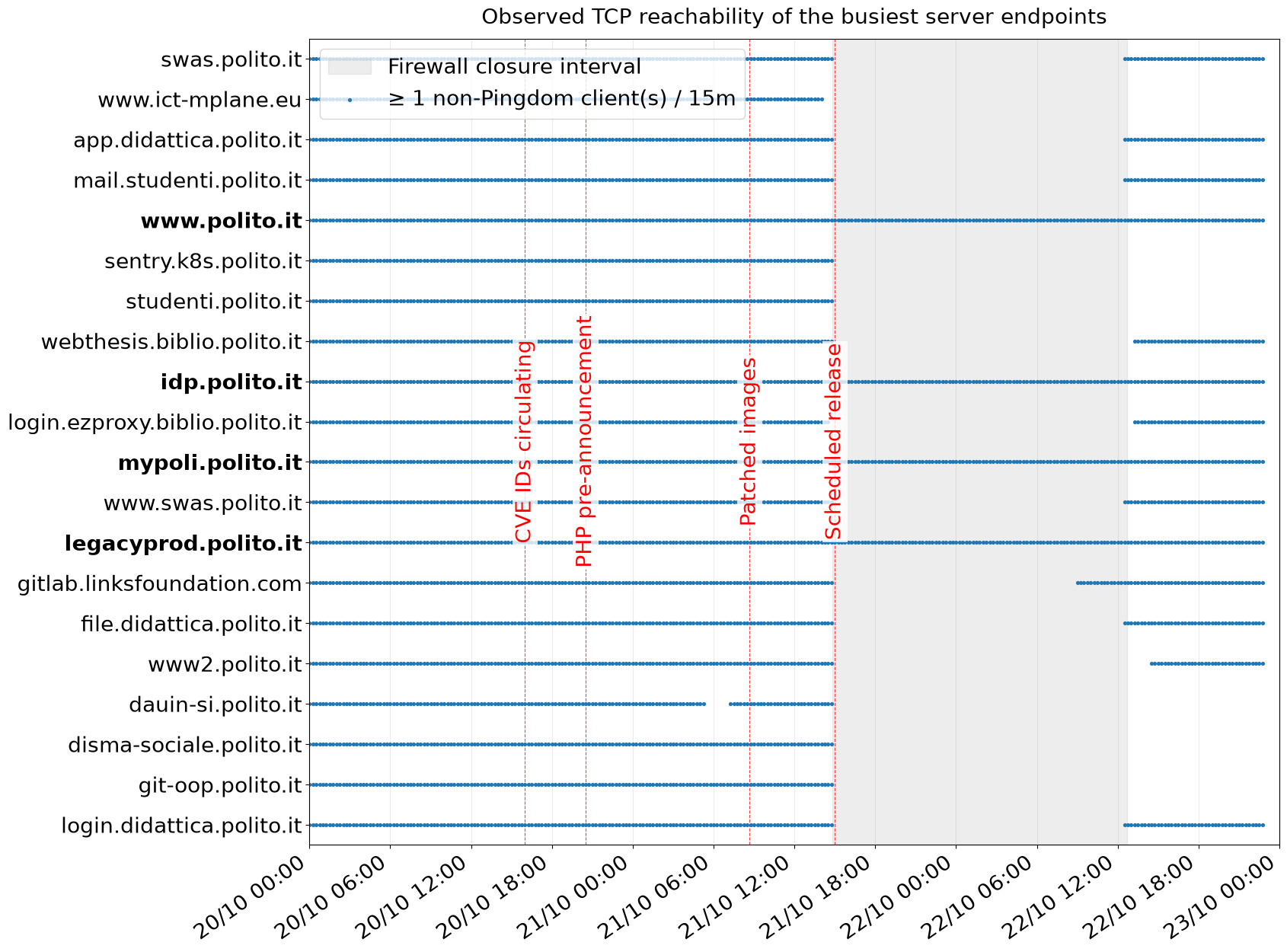
External access and application functionality: two different aspects.
Centrally managed PHP websites were initially protected by restrictions, except for SSO. MyPoli and didattica.polito.it do not use PHP and remained available. For www.polito.it, a server response could simply be a courtesy page.
An interruption visible in the data
- app.didattica.polito.it
- file.didattica.polito.it
- mail.studenti.polito.it
During the restriction, observed completed connections from ordinary clients disappeared; they returned after access was restored.
Teaching Portal, MyPoli and SSO remained available
- idp.polito.it · SSO authentication
- mypoli.polito.it · not PHP-based
- didattica.polito.it · not PHP-based
Although it uses PHP, SSO remained available externally to allow authentication and was the first service patched. MyPoli and didattica.polito.it were not among the PHP websites requiring patches. The Teaching Portal remained open throughout and is by far the University’s highest-traffic website. Its continued availability should be distinguished from the restrictions affecting app.didattica.polito.it and file.didattica.polito.it.
The University website. www.polito.it continued responding, but Drupal was initially disabled and an “offline” courtesy page was displayed. A completed connection therefore does not establish that the website was fully operational.
When a connection fails.
Green indicates completed connections. Red indicates attempts that did not complete connection establishment.
The effect of the restriction is clear.
For app.didattica.polito.it, the green curve stops during the grey interval. Attempts continue, but do not become completed connections.
Once access is restored, green reappears and red decreases. This pattern is consistent with the restriction being lifted.
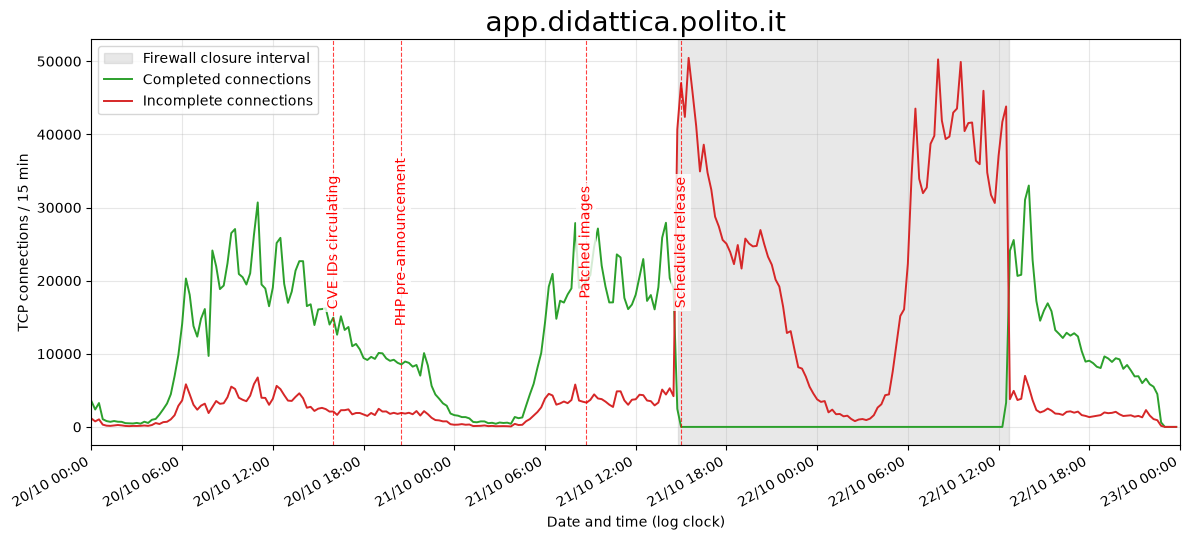
The grey band highlights the precautionary restriction interval. The axis counts connections, not users.
Student email: why exclude automated checks?
The service mail.studenti.polito.it also shows an interruption in ordinary connections. During the restriction, a few automated Pingdom probes could still connect because they were allowed through the firewall. They were excluded from the reachability overview; otherwise, they would have made the service appear continuously accessible.
The interval contains 1,207 completed connections from 13 addresses, all verified against the probe list. The volume chart includes these checks; the 20-service overview excludes them.
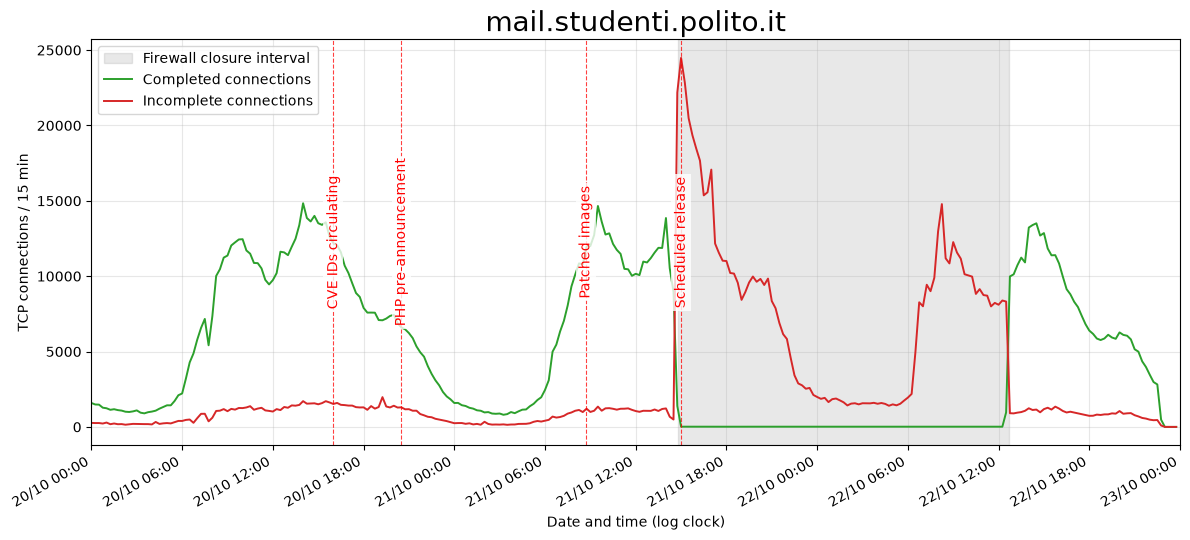
The small residual number of completed connections comes from authorised probes; at this scale it appears close to zero.
Reachability does not tell the whole story.
Select a service to view the operational decisions alongside the data. For the University website, the connection curve also includes the courtesy-page phase.
University website
www.polito.it
The website uses Drupal/PHP and was affected by the vulnerabilities. Drupal was initially disabled and the server responded with an “offline” courtesy page. At 22:03 on 21 October, following mitigation measures, the website was already substantially operational. Mauro Innocenti completed the update of www.polito.it at 13:30 on 22 October.
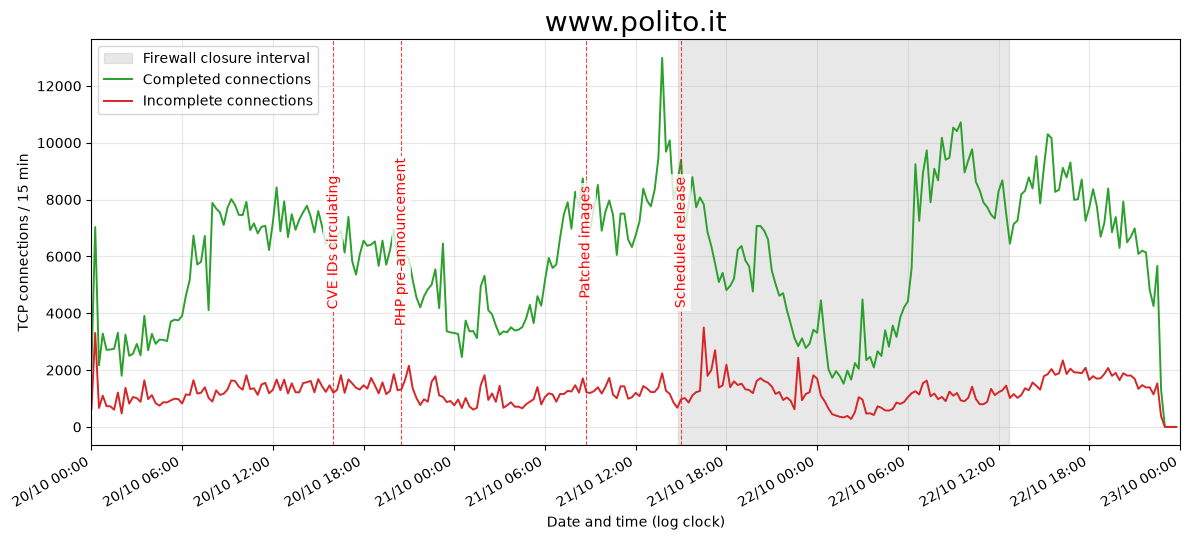
The green curve also includes connections to the courtesy page. Continuous TCP responses do not imply continuous availability of the Drupal website.
From the courtesy page to the patched website
Connections continued to complete while the courtesy page was displayed. The amount of data sent by the server helps distinguish this phase: the median drops to about 5.15 KiB per connection and rises again when the website returns with mitigations in place.
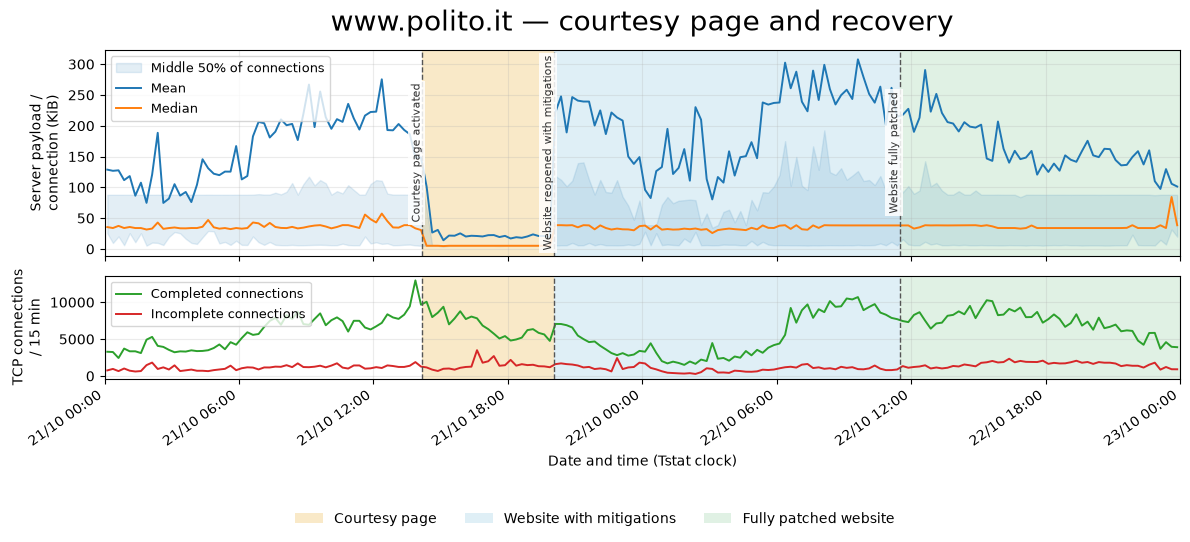
The courtesy-page phase starts at 14:11 on 21 October on the Tstat clock; the brief reopening test is included in the same phase. For this detailed view, 20:03 Tstat corresponds to 22:03 CEST on 21 October, and 11:30 Tstat to 13:30 CEST on 22 October. These correspondences do not change the general timeline. Full patching is documented by operational information; byte volumes alone do not establish it.
Identity service
idp.polito.it
The SSO authentication portal uses PHP and remained available externally to allow access to services. Andrea Garzena patched it first, at 18:21 on 21 October, as soon as the patches became available. Brief spikes in incomplete connections do not correspond to a general authentication outage.
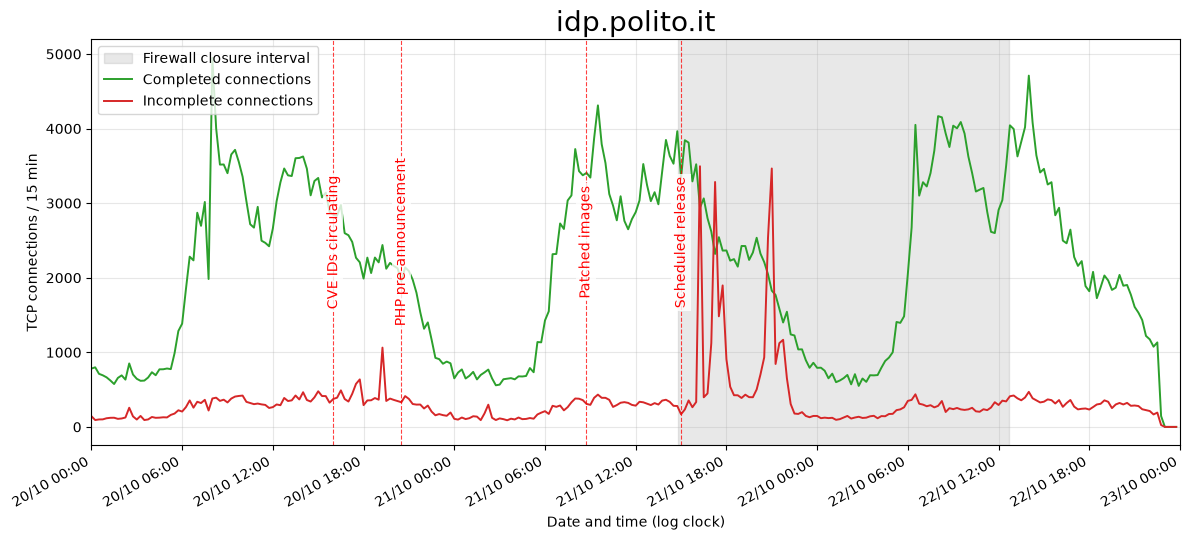
The red spikes do not coincide with a general interruption of completed connections.
MyPoli
mypoli.polito.it
MyPoli does not use PHP and remained reachable externally. It also prominently displayed the notice to the community. The chart shows some spikes in incomplete attempts while completed connections continue: those spikes do not indicate that the portal was blocked.
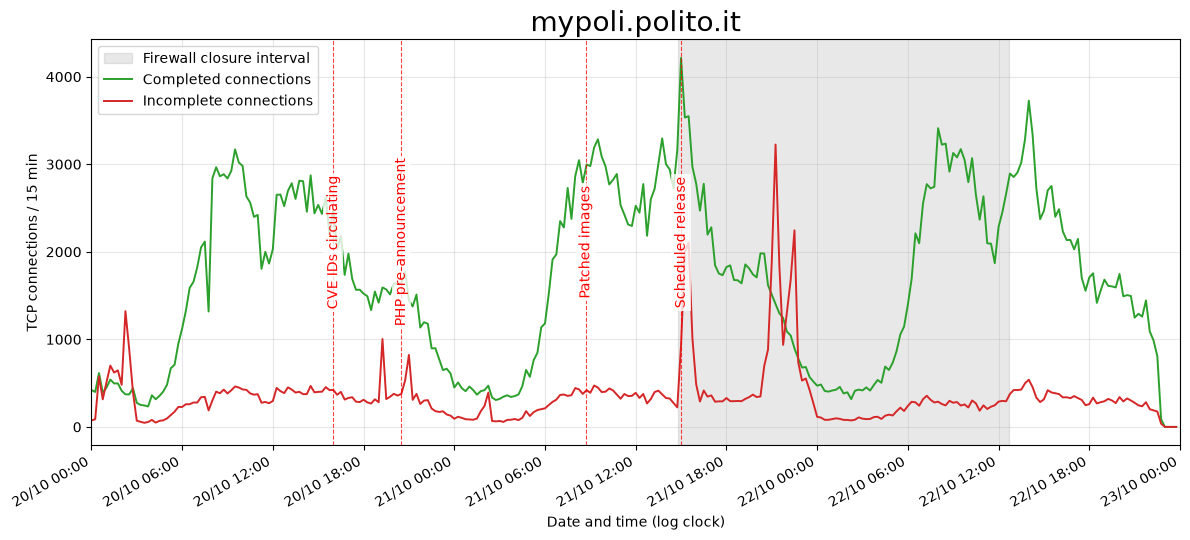
Temporary increases in red require additional evidence to interpret.
An update at every stage.
Emails, portal notices, app notifications and the status page accompanied the response. The initial estimates were followed by updates on service restoration.
The precautionary notice
Bilingual email to students and staff. It announced the suspension of access until the following morning, with restoration subject to security checks.
Read the original message · IT / EN
Italian original
A tutti gli studenti
A tutto il personale
Care studentesse e cari studenti, gentili colleghe e gentili colleghi,
a seguito della segnalazione di vulnerabilità critiche nel software PHP, il Politecnico di Torino sospenderà in via precauzionale l’accesso ai servizi web dell’Ateneo dalle ore 15.50 di oggi, mercoledì 21 ottobre, fino alla mattina di giovedì 22 ottobre.
Il personale ISIAD sta verificando i sistemi e applicando gli aggiornamenti necessari. La riattivazione avverrà dopo il completamento delle verifiche di sicurezza; comunicheremo tempestivamente eventuali variazioni rispetto alla durata prevista.
Ci scusiamo per il disagio e vi ringraziamo per la collaborazione.
Direzione ISIAD
Politecnico di Torino
English
Dear students and colleagues,
Following reports of critical vulnerabilities in PHP, Politecnico di Torino will suspend access to the University’s web services as a precaution from 3:50 p.m. today, Wednesday 21 October, until the morning of Thursday 22 October.
ISIAD staff are checking the systems and applying the necessary updates. Services will be restored once the security checks are complete. We will promptly inform you of any changes to the expected duration of the suspension.
We apologise for the inconvenience and thank you for your cooperation.
Direzione ISIAD
Politecnico di Torino
An update on service restoration
The University website, MyPoli, UGOV, staff email and collaboration tools were available. External access to the Student App, student email and teaching-material downloads remained restricted.
Read the original update · IT / EN
Italian original
A tutto il Personale
[English version follows]
Gentili colleghe e gentili colleghi,
Facendo seguito alle comunicazioni di ieri, vi aggiorniamo sulla riattivazione dei servizi dell’Ateneo dopo l’intervento cautelativo legato alle vulnerabilità PHP.
Sono attualmente disponibili:
- Il sito di Ateneo www.polito.it, l’intranet MyPoli, i servizi su UGOV (Missioni, IRIS, UGOV, …).
- La posta elettronica del personale, Teams e gli altri strumenti di collaborazione funzionano regolarmente.
- Il Portale della Didattica (ad esclusione del download del materiale didattico dall’esterno).
- Le videolezioni – solo su piattaforma Zoom al momento.
- Gli strumenti per avvisare gli studenti (via notifica o sms).
L’accesso all’email da parte degli studenti e l’uso dell’App studenti sono al momento consentiti solo dalla rete interna del Politecnico.
Tutti i servizi restano accessibili, comunque, dalla rete interna del Politecnico, via WiFi, o via VPN.
Nelle prossime ore prevediamo di riattivare l’accesso da rete esterna per il funzionamento completo dell’App studenti, la posta elettronica degli studenti, il download del materiale didattico e altri siti istituzionali.
Abbiamo chiesto ai referenti IT dei Dipartimenti di aggiornare i server di loro competenza. I relativi servizi saranno riattivati progressivamente, dopo l’applicazione delle correzioni e le verifiche necessarie.
Vi terremo informati sugli ulteriori sviluppi. Grazie per la collaborazione.
Giorgio Santiano
Direzione ISIAD
Politecnico di Torino
English
Dear colleagues,
Following yesterday’s communications, we would like to update you on the restoration of University services after the precautionary measures taken in response to the PHP vulnerabilities.
The following services are currently available:
- The website www.polito.it; the MyPoli intranet; and UGOV services (Missions, IRIS, UGOV, etc.).
- Staff email, Teams and other collaboration tools are operating normally.
- The Teaching Portal, except for downloading teaching materials from outside the Politecnico network.
- Online lectures, currently only via Zoom.
- Tools for notifying students by push notification or SMS.
Students can currently access their email and use the Student App only from within the Politecnico network.
All services remain accessible from within the Politecnico network, via WiFi or VPN.
Over the next few hours, we expect to restore external access to the full functionality of the Student App, student email, downloads of teaching materials and other institutional websites.
We have asked departmental IT contacts to update the servers under their responsibility. The corresponding services will be restored progressively once the patches have been applied and the necessary checks completed.
We will keep you informed of further developments. Thank you for your cooperation.
Giorgio Santiano
Direzione ISIAD
Politecnico di Torino
Restoration of centrally managed services
An email and a notice on status.polito.it confirmed that the remaining restrictions on centrally managed services had been lifted. Some services on departmental servers remained unavailable, with gradual restoration planned.
Read the original message · IT / EN
Italian original
A tutto il Personale
[English version follows]
Gentili colleghe e gentili colleghi,
facendo seguito alle precedenti comunicazioni, vi informiamo che tutti i servizi gestiti centralmente dall’Ateneo sono tornati regolarmente disponibili, anche dalla rete esterna. Sono quindi state rimosse le ultime limitazioni che riguardavano l’App studenti, la posta elettronica degli studenti e il download del materiale didattico.
Restano ancora non disponibili alcuni servizi ospitati sui server dei Dipartimenti, dove i referenti IT stanno applicando gli aggiornamenti di sicurezza necessari; i servizi saranno riattivati progressivamente dopo le opportune verifiche.
Vi ringraziamo per la pazienza e la collaborazione.
Colgo l’occasione per ringraziare tutti i colleghi di ISIAD che hanno saputo gestire questa emergenza con professionalità, dedizione e tempestività.
Giorgio Santiano
Direzione ISIAD
Politecnico di Torino
English
Dear colleagues,
following our previous communications, we would like to inform you that all centrally managed University services are now operating normally, including access from outside the Politecnico network. The remaining restrictions affecting the Student App, student email and downloads of teaching materials have therefore been lifted.
Some services hosted on departmental servers are still unavailable. Departmental IT contacts are applying the necessary security updates; these services will be restored progressively after the appropriate checks.
Thank you for your patience and cooperation.
I would also like to thank all my ISIAD colleagues for handling this emergency with professionalism, dedication and promptness.
Giorgio Santiano
Direzione ISIAD
Politecnico di Torino
The first message was prominently displayed on MyPoli and on didattica.polito.it, which remained accessible throughout. All students received an app notification about the closure.
A detailed update on external access restrictions was published at 22:29 on 21 October. The closure notice of 23 October is available in the communications archive.
A snapshot beyond Polito.
On the evening of 21 October, a homepage check also found access difficulties at other university web addresses.
The check was carried out between 22:28 and 22:29 on 21 October, Italian local time. Three websites displayed a likely temporary or maintenance page; the other ten cases involved network or certificate errors, server errors or denied access.
At the time of the check, Polito was already back online and operational: the “homepage reachable” result for the University website was therefore correct.
Results and limitations of the check
| Result | Number of URLs |
|---|---|
| Homepage classified as reachable | 86 |
| Likely temporary or maintenance page | 3 |
| Network or certificate verification error | 7 |
| Server error, HTTP 502 / 504 | 2 |
| Access denied, HTTP 403 | 1 |
| Login form detected | 2 |
| Content requiring review | 1 |
The likely maintenance pages were at IMT Lucca, Università del Sannio and SISSA. The two login forms and the additional content requiring review were not counted among the 13 cases with errors or restrictions.
The check followed redirects and verified certificates, automatically classifying homepage content. The sample includes a URL whose title indicates a domain for sale: it should not be treated as a validated census of Italian universities. An error may predate the incident or depend on the access point; the check does not measure how long the problem lasted.
Three findings to understand the event.
Attempts spread across many sources
For app.didattica, more than two million incomplete attempts were observed across approximately 58,000 addresses. The ten most active accounted for only 1.53%: the increase was widespread.
A completed connection does not imply an operational website
The courtesy page on www.polito.it produces completed connections just like a normal web page. Operational information identifies the Drupal interruption that the connection chart alone does not reveal.
A spike does not establish exploitation
An attempt can fail because of a restriction, a network problem or automated behaviour. These data cannot attribute the spikes to exploitation of PHP2SHELL.
The numbers compared: a detailed view
Incomplete connections in two 21-hour, 54-minute windows, at the same times on consecutive days. These are counts of attempts, not people. The reference day may have different characteristics.
| Service | Previous day | During the event | Ratio |
|---|---|---|---|
| app.didattica.polito.it | 181,046 | 2,064,403 | 11.40× |
| www.polito.it | 105,491 | 99,857 | 0.95× |
| idp.polito.it | 24,917 | 41,793 | 1.68× |
| mypoli.polito.it | 25,867 | 39,283 | 1.52× |
For app.didattica, the pattern is consistent with a widespread effect of the restriction. For idp and MyPoli, which remained operational, the ratios describe traffic changes. For www.polito.it, the server response, including the courtesy page, must be distinguished from application functionality. None of these ratios alone proves an attack.
A coordinated response.
Restoration by priority.
At 17:58 on 23 October, full availability of centrally managed services was announced, including external access. As of this reconstruction, on 1 November 2026, collaboration with departments continues to patch the websites they host and manage.
How to read this reconstruction.
Could I access services from home?
Yes. With the VPN connected, access was also possible off campus. The restrictions applied to access coming directly from external networks; services remained reachable from the campus network and Politecnico Wi-Fi.
Did incident closure also cover all departmental websites?
The communication of 23 October at 17:58 confirms full restoration of centrally managed services. It also notes that some departmental services were still unavailable. As of 1 November 2026, the date of this reconstruction, collaboration with departments continues to patch the websites they manage.
Why did some services remain reachable?
MyPoli and didattica.polito.it do not use PHP and were not among the websites requiring updates. The Teaching Portal, by far the University’s highest-traffic website, remained open throughout. The identity service uses PHP but remained available to support authentication and was patched as a priority. Initially, www.polito.it responded with a courtesy page while Drupal was disabled: this should not be confused with a fully operational website.
Does an empty row mean the service was unreachable?
It means that no completed connection was observed for that endpoint during that 15-minute interval, excluding Pingdom probes. This is useful evidence, particularly when it coincides with the restriction, but it is not proof for every possible user, network path or feature.
Does an increase in failed attempts mean there was an attack?
No. Browsers and applications retrying access can also generate many failed attempts. Additional evidence is needed to classify activity as malicious. Public checks on the most active addresses produced no verifiable report; this does not establish that the addresses are trustworthy.
Does this analysis establish whether data were stolen?
No. The reconstruction concerns connection establishment and observed reachability. It cannot establish whether a vulnerability was exploited or whether data were affected.
Sources and limitations of the analysis
The reconstruction is based on analysis of logs produced by Tstat (TCP STatistic and Analysis Tool), a passive monitoring tool used to collect statistics on all traffic on the Politecnico di Torino network. Tstat reconstructs network flows and records connection statistics, including data volumes, timing and TCP anomalies. This study analysed logs for 20–22 October 2026. The analysis is complemented by the operational timeline and communications supplied by the response coordinators, and by the national check report of 21 October. The observed traffic consists of HTTPS connections from addresses classified as external to internal servers. The overview selects the 20 most active endpoints before the response and excludes Pingdom checks; the volume charts retain those checks.
Endpoints are identified by service name and destination address. Incomplete connections are selected by server address. In the original figures, “Completed” means completed connections; “Incomplete” means that connection establishment did not complete.
The figure timestamps follow the logger clock, labelled as UTC in the data. The alignment with public events assumes a one-hour offset, which remains to be validated on the acquisition system. The operational communication times in the timeline were not derived from the charts or converted to the logger clock. The courtesy-page detailed view retains the specific correspondences with CEST stated in its caption; these are not applied to the other charts. Bytes represent server payload per TCP connection, not the size of a single HTTP page; this detailed view excludes Pingdom checks. The analytical window runs from 21 October at 14:48 to 22 October at 12:42 on the log clock; the comparison uses the same times on the previous day.
This is a historical snapshot: the presence of connections does not certify that every application was functioning or describe the current status of services.
Scientific references on Tstat
- M. Mellia, R. Lo Cigno, F. Neri, Measuring IP and TCP behavior on edge nodes with Tstat, Computer Networks, 47(1), pp. 1–21, 2005.
- A. Finamore, M. Mellia, M. Meo, M. M. Munafò, D. Rossi, Experiences of Internet Traffic Monitoring with Tstat, IEEE Network, 25(3), pp. 8–14, 2011.