
Probing web services.
Few targets, many connections.
Twelve AWS sources appear after disclosure and concentrate thousands of connections on a few services. Five share a fingerprint in their OAST identifiers. A China Telecom source follows a different pattern.
Follow the AWS sources ↓Among the most active sources contacting web servers, some show repetitive activity concentrated on a few addresses. For five AWS sources, the correlation between identifiers is consistent with a possible common probing infrastructure.
Proximity to disclosure and the use of OAST do not establish a PHP2SHELL exploit. Network logs show TCP exchanges and some TLS metadata, but not the contents of HTTP requests.
From networks to services.
A sample selected by number of attempts, examined through TCP exchanges carrying data.
Part B follows clients that explore a large number of addresses. Here we focus on IPs associated with Polito web services and on the sources making the most attempts. The initial selection includes complete and incomplete connections; the main sample retains only exchanges with bidirectional payload during the restrictions.
270 IPs associated with Polito names.
Each address is identified by at least one TLS flow with SNI polito.it or *.polito.it . The inventory contains 1,585 IP–hostname pairs and may include virtual hosting.
From 50 candidates to 17 sources.
Among the 50 IPs with the most attempts and first observation on or after 20 October at 16:00, we retain those with at least 100 bidirectional flows during the firewall interval. Together, they reach 30 IPs in the inventory.
| Origin | Clients | Bidirectional flows | Interpretation |
|---|---|---|---|
| AWS EC2 · AS16509 | 12 | 83,044 | Main focus |
| CyCognito prefix | 2 | 11,104 | Consistent with commercial reconnaissance / EASM |
| China Telecom · AS4134 | 1 | 748 | Independent case |
| Telecom Italia and Fastweb | 2 | 636 | Possible aggregated end-user traffic |
A flow is not equivalent to a successful web request. The filter requires client data packets and unique server bytes; even an interrupted TLS handshake can meet these conditions. An access-network IP may aggregate multiple users: CGNAT has not been verified for these sources.
CyCognito and access networks: what we know
The two IPs 204.62.215.1 and 204.62.215.43 belong to a block registered to CyCognito and announced by AS396982, Google Cloud. The origin AS and the block registrant describe different aspects; neither alone identifies who initiated each connection.
82.54.158.95 is registered to Telecom Italia; 37.186.234.114 is associated with Fastweb, with the network registration FASTWEB-STARHOTELS. The available information does not establish that these are two individual residential users or that they use CGNAT.
Progressive arrivals, few targets.
The sources appear after the official marker and produce dense sequences of connections to specific services.
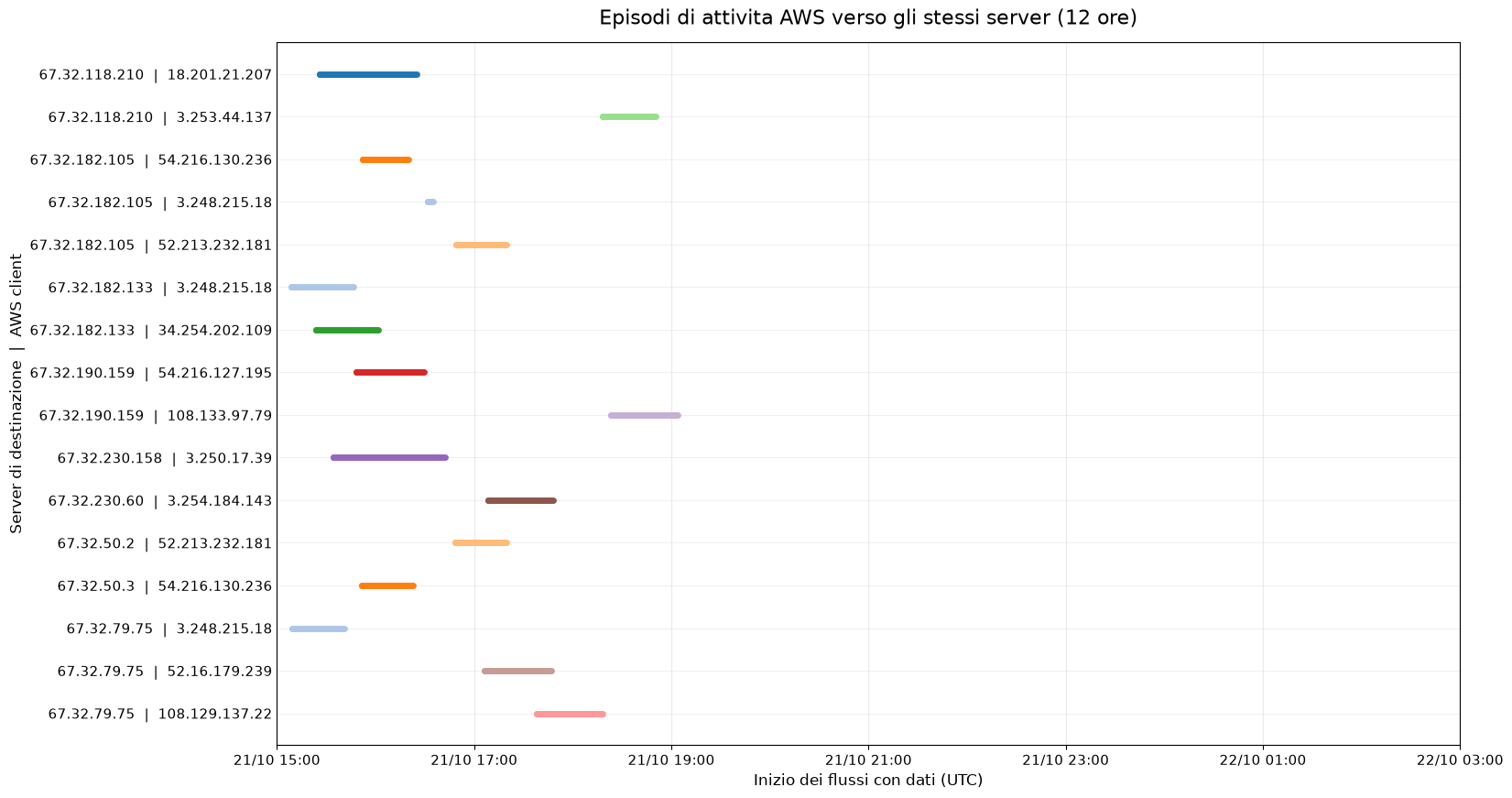
The 12 sources are associated with AS16509 and EC2 names in the region eu-west-1. The first appears at 15:08:28 on 21 October, around eight minutes after the disclosure marker; the others arrive progressively until 18:18. Each IP concentrates its bidirectional flows on one to three servers.
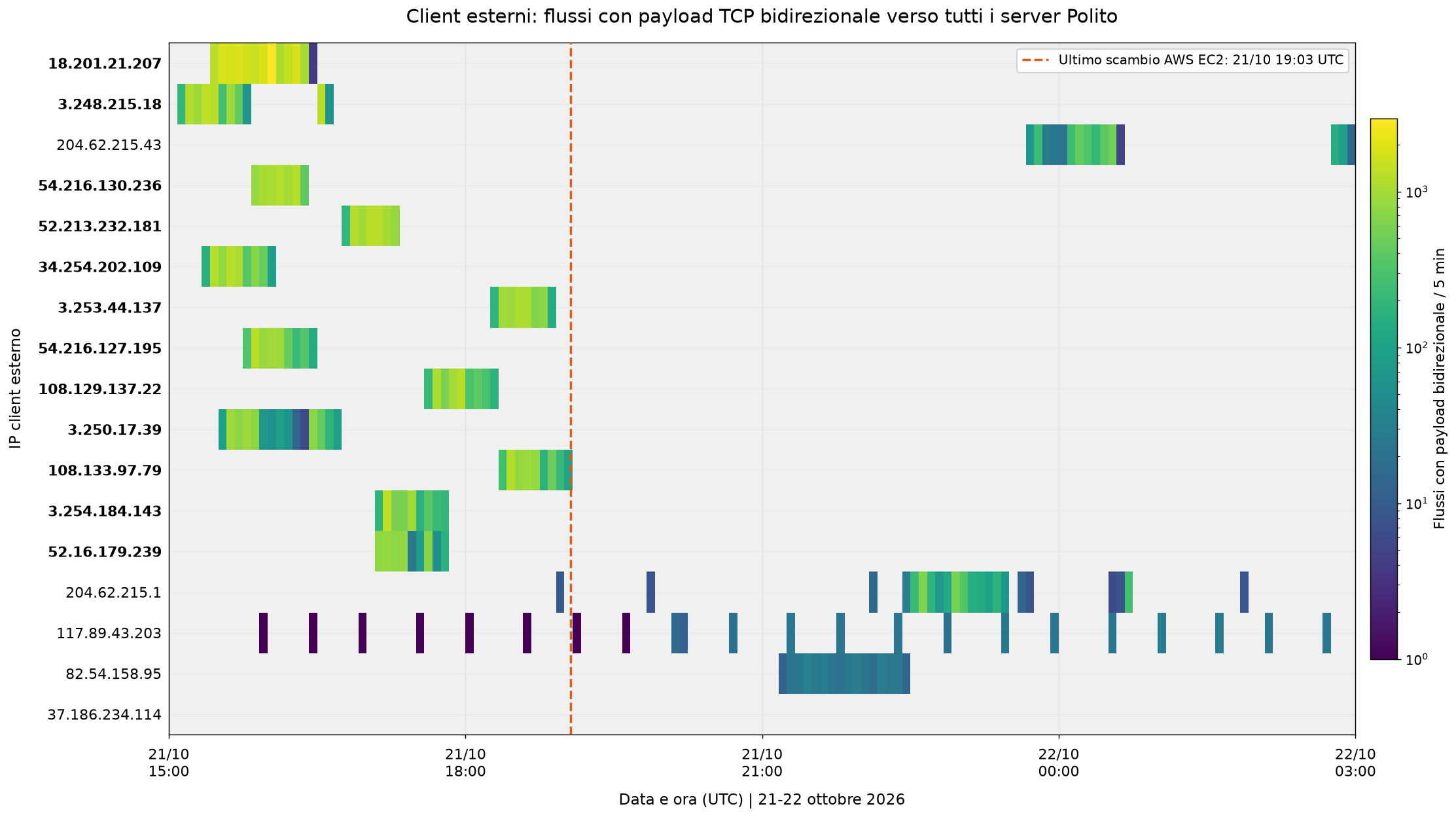
Data exchanges are concentrated in the afternoon; attempts continue for longer.
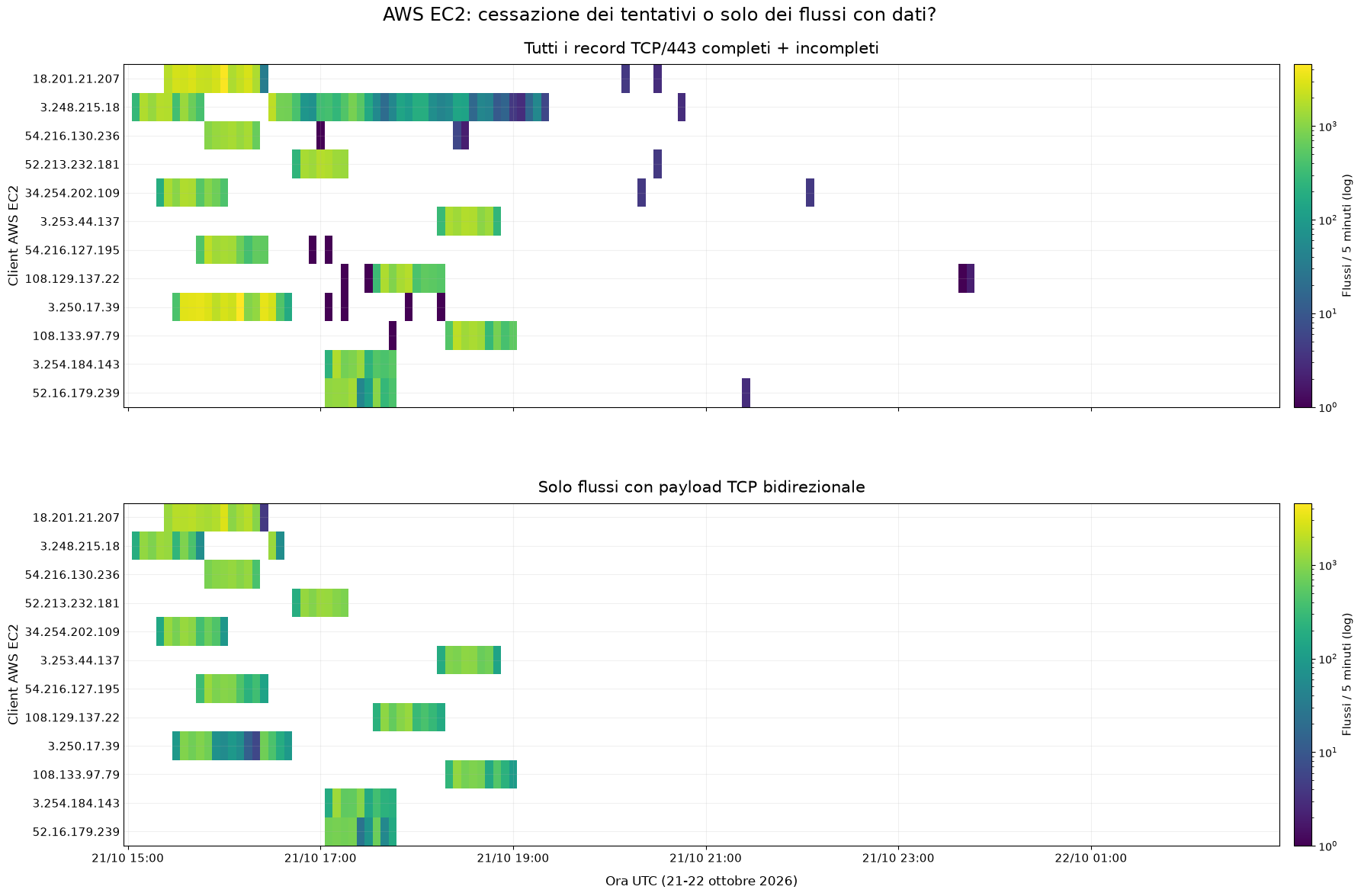
Within the 12 hours, we observe 156,380 AWS attempts towards inventory IPs, including 83,044 with bidirectional payload. The last attempt towards this inventory occurs at 23:45:51 on 21 October. No further attempts from these sources towards the same IPs appear in the remaining capture records.
The main episodes generally last 30–70 minutes and show peaks of 28–57 new flow starts per second per source. This measures the initiation rate, not the number of simultaneously active connections.
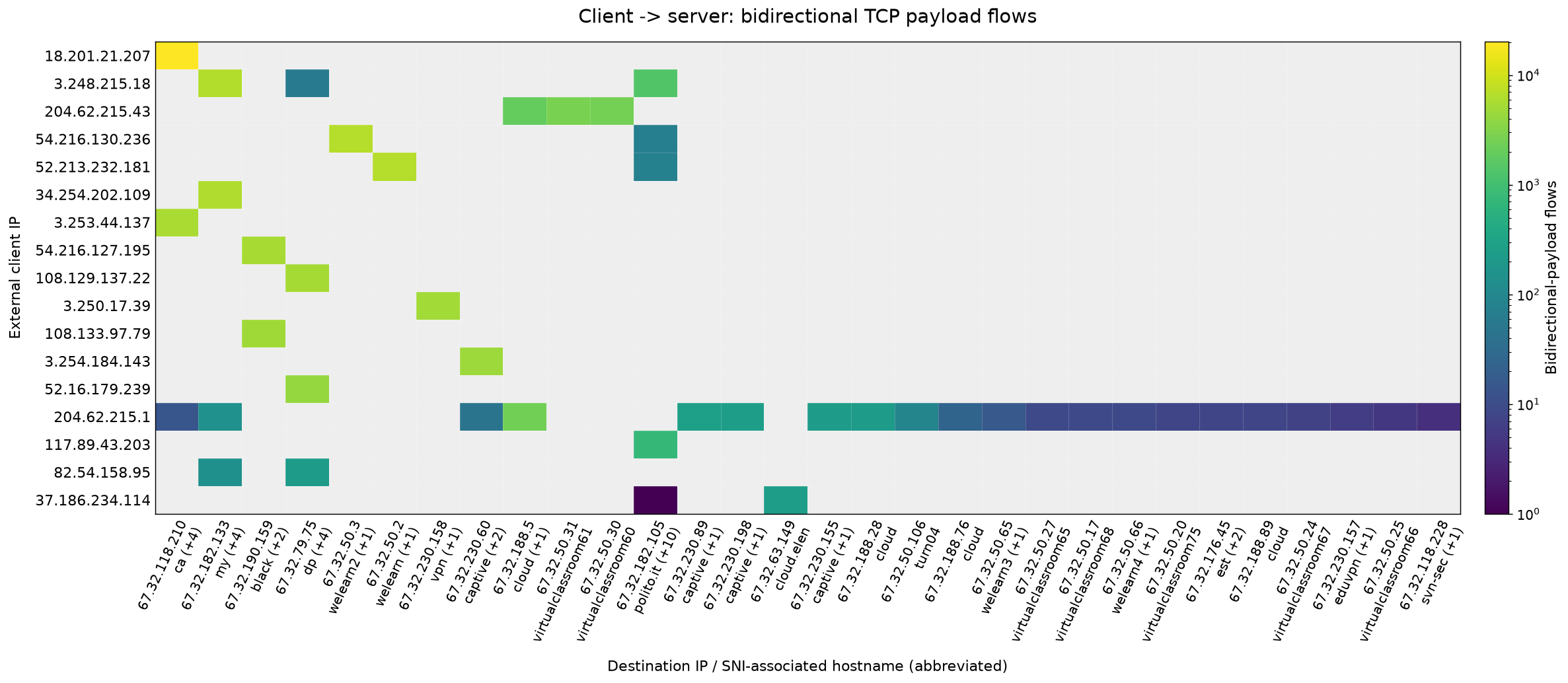
Explore further: attempts, episodes and client–server pairs
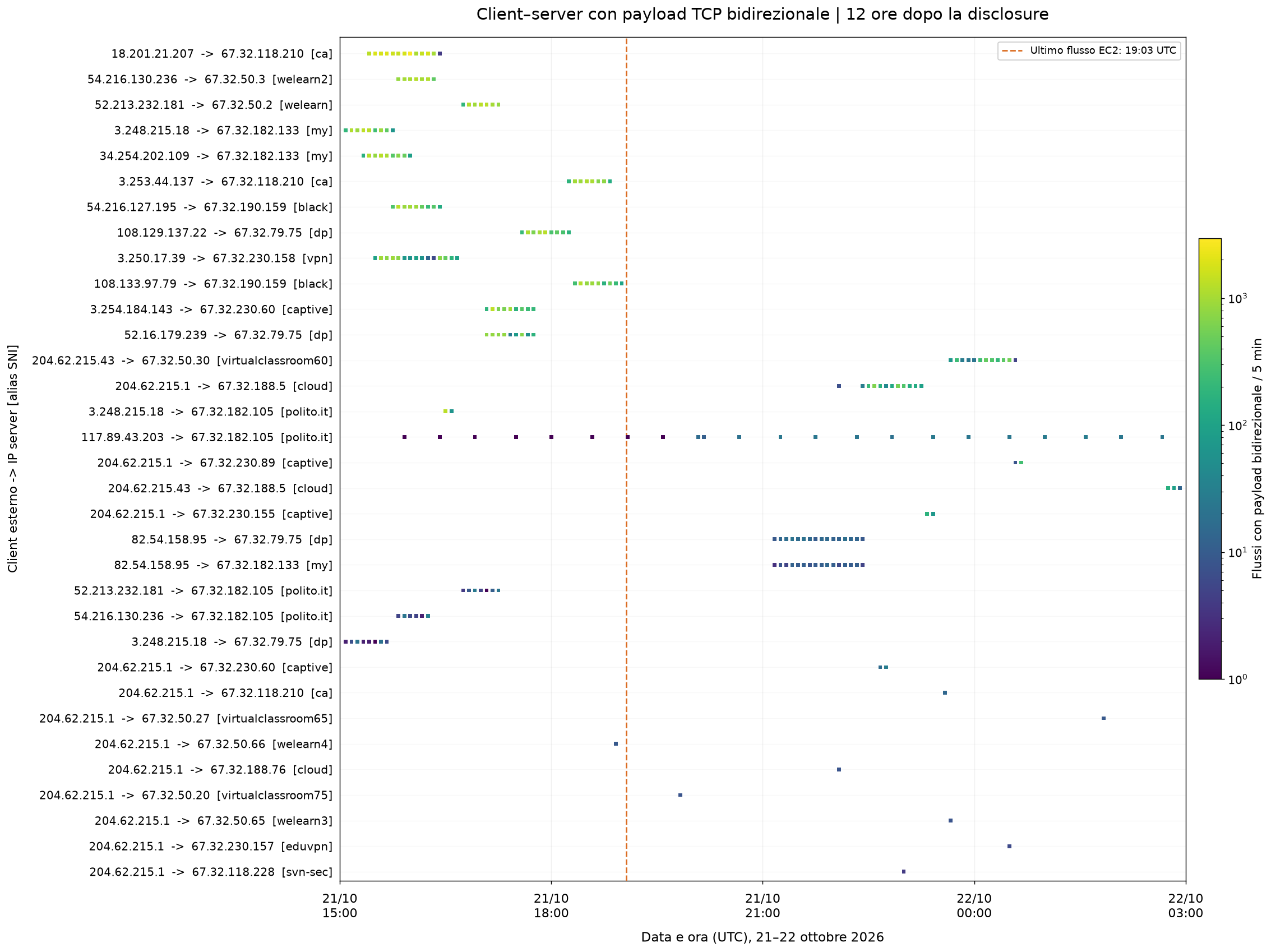
Five IPs, one common fingerprint.
A link in software-generated tokens, more specific than simply sharing the same cloud provider.
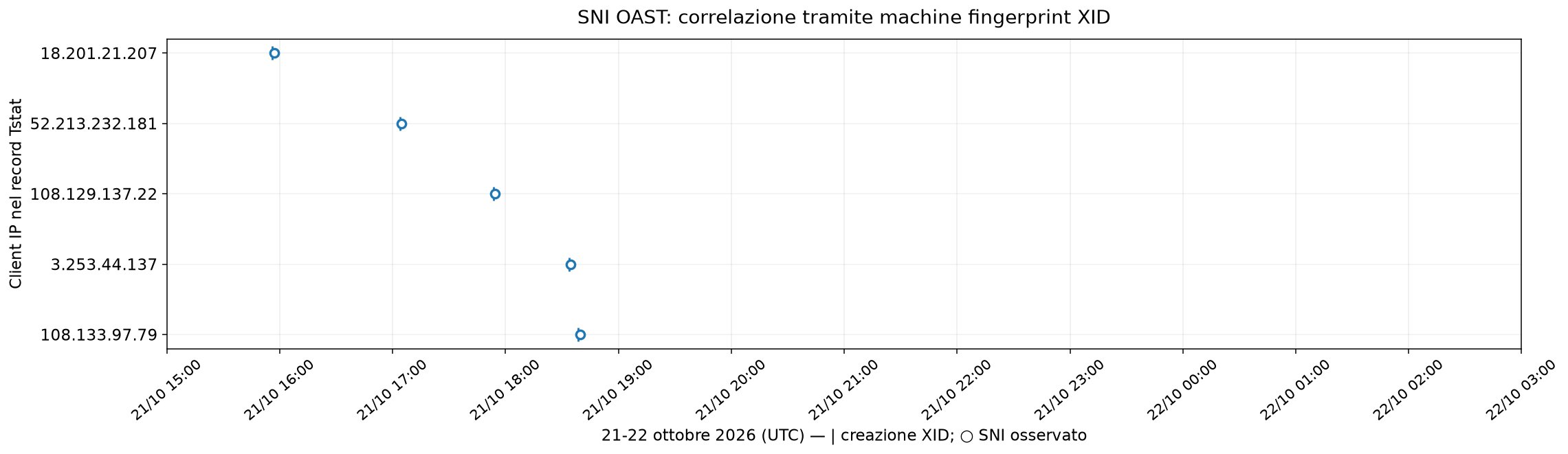
Five AWS sources each send an SNI under a domain in the Interactsh/OASTfamily, used in out-of-band security testing. The five hostnames differ, but their embedded XID identifiers share the same machine fingerprint .
The shared fingerprint
e81ff8
It appears in all five identifiers, with five different process IDs. This suggests a common generator or software environment; it does not identify a physical machine or an operator.
How the identifier is structured
The observed token is compatible with the 33-character Interactsh format: 20 characters for the correlation ID and 13 for the nonce. XID decoding of the first 20 characters yields 12 bytes:
A compatible structure and plausible timestamps support the XID interpretation. The fingerprint may be shared or configured across different environments.
| Source IP | Domain | XID machine ID | Process ID | Tstat time | Apparent delay |
|---|---|---|---|---|---|
18.201.21.207 | oast.site | e81ff8 | 6728 | 15:56:59.891 | 53.891 s |
52.213.232.181 | oast.pro | e81ff8 | 30873 | 17:04:43.859 | 48.859 s |
108.129.137.22 | oast.fun | e81ff8 | 64258 | 17:54:26.902 | 47.902 s |
3.253.44.137 | oast.site | e81ff8 | 35056 | 18:34:35.183 | 48.183 s |
108.133.97.79 | oast.online | e81ff8 | 1467 | 18:39:33.841 | 47.841 s |
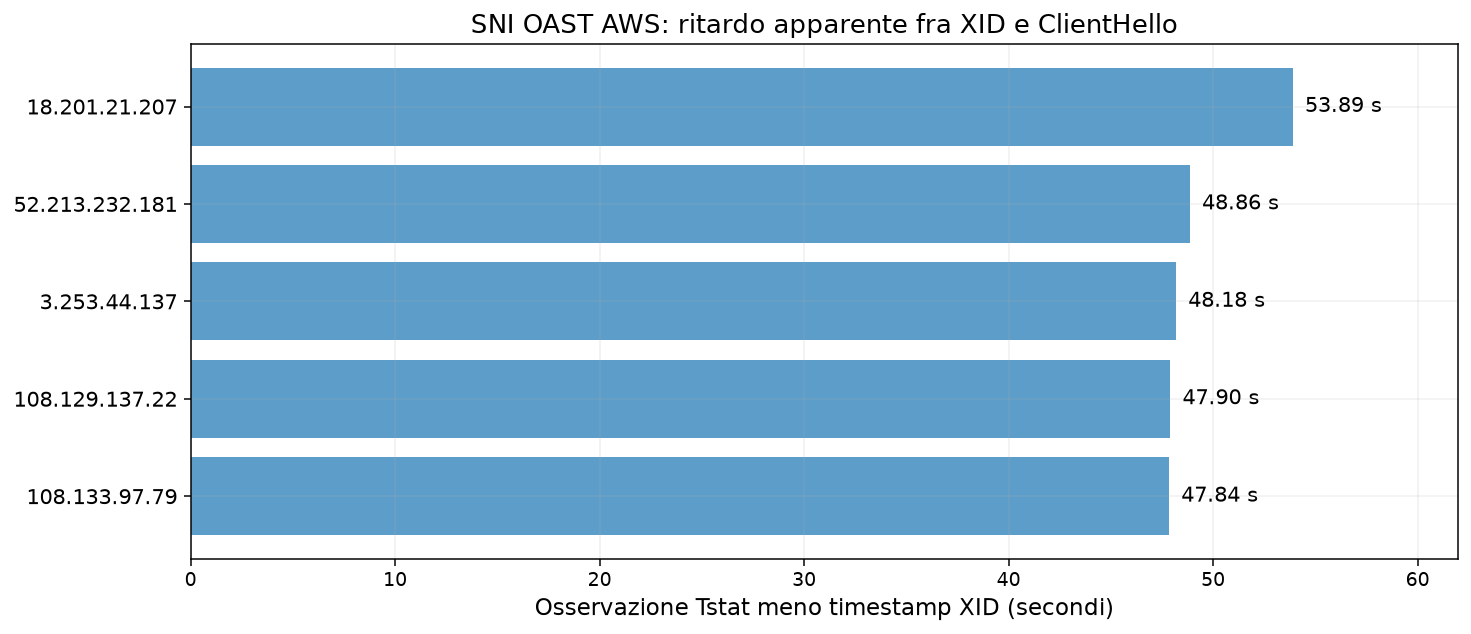
…oast.*Polito serverThe observed direction is from the client to Polito. These five events are not callbacks from Polito servers to OAST. The identifiers do not demonstrate successful exploitation, the use of Nuclei, or a test specifically targeting PHP2SHELL.
The search for OAST SNI values, extended to all complete TCP records in the capture, beyond the 12 AWS sources and the web inventory, finds only the same five events and the same five sources. No other IPs with this fingerprint emerge through the visible SNI values.
Full hostnames and the XID timeline
18.201.21.207—dbce15n83vs1ki11sh5g3576iufkwcidk.oast.site52.213.232.181—dbcf0uv83vs7h6btrvjg53eag7borna9w.oast.pro108.129.137.22—dbcfo8v83vsfm0n7tn4ggxof8sfyxk7mj.oast.fun3.253.44.137—dbcgb2v83vs8hs3sc9t0aescf5pqqzydn.oast.site108.133.97.79—dbcgddn83vs0bepitcvgctmyyqy4pb917.oast.online
Exchanging data does not mean receiving a web page.
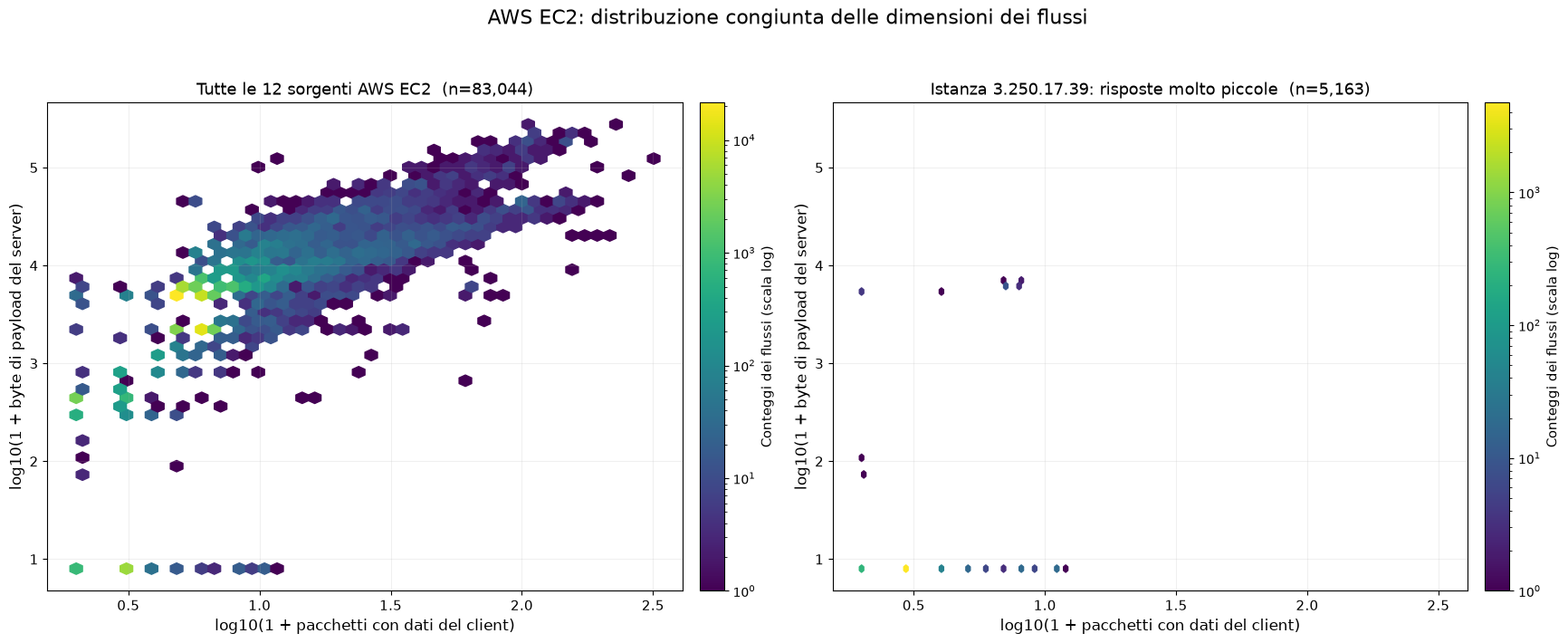
Short responses and resets are also part of the evidence; they must not be mistaken for application-level success.
Repetition also appears in server bytes, client data packets and TCP resets. The AWS sources nevertheless have different profiles: a common EC2 region is not enough to assume that they all run the same software.
Recurring 2,060-byte responses.
20,098 bidirectional flows. The server payload median and p90 are both 2,060 bytes; 92.6% of flows contain at least one server-side RST.
A response may be just 7 bytes.
5,163 bidirectional flows. The median and p90 are 7 bytes; 97.5% contain a server-side RST. The filter captures a TCP exchange even when the protocol is immediately interrupted.
SNI is recorded in 29,329 of the 102,354 complete AWS records (28.7%). Five sources exceed 90% coverage, while the other seven remain below 1.3%. “SNI not observed” does not necessarily mean that the client did not send it.
SNI coverage by source

China Telecom follows a different pattern.
Similar services of interest, but different timing, pacing and metadata from the AWS sources.
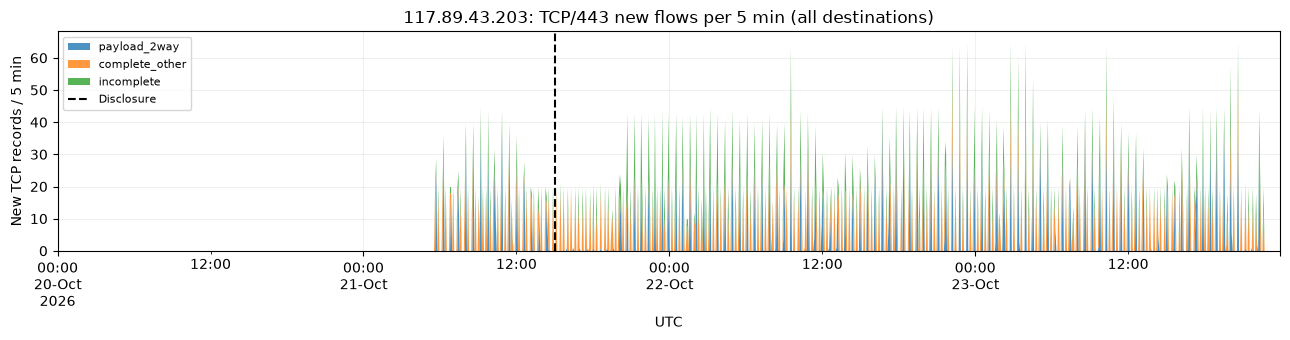
117.89.43.203, associated with AS4134 China Telecom, is active from 05:37 on 21 October to 22:39 on 23 October. Activity begins around nine hours and 23 minutes before the disclosure marker and continues over several days.
Across the full capture, it produces 8,506 TCP/443 attempts towards two IPs: 2,856 bidirectional flows, 3,576 other complete records and 2,074 incomplete records. The SNI values observed in bidirectional flows are www.polito.it (2,425 flows) and www2.polito.it (431). No OAST SNI is observed.
| Characteristic | 12 AWS sources | China Telecom |
|---|---|---|
| First observation towards the inventory | 21/10 · 15:08:28, after disclosure | 21/10 · 05:37:17, before disclosure |
| Last attempt towards the inventory | 21/10 · 23:45:51 | 23/10 · 22:39:18 |
| Peak new TCP starts per second | 28–57 per IP, within the 12 hours | 2, across the full capture |
| Bidirectional flows to 67.32.182.105, same firewall interval | 1,513, from three AWS sources | 748 |
| Median server bytes on the same IP, firewall interval | 4,793–5,274 bytes per source | 9,138 bytes |
| Observed OAST SNI | 5 events from 5 IPs | None |
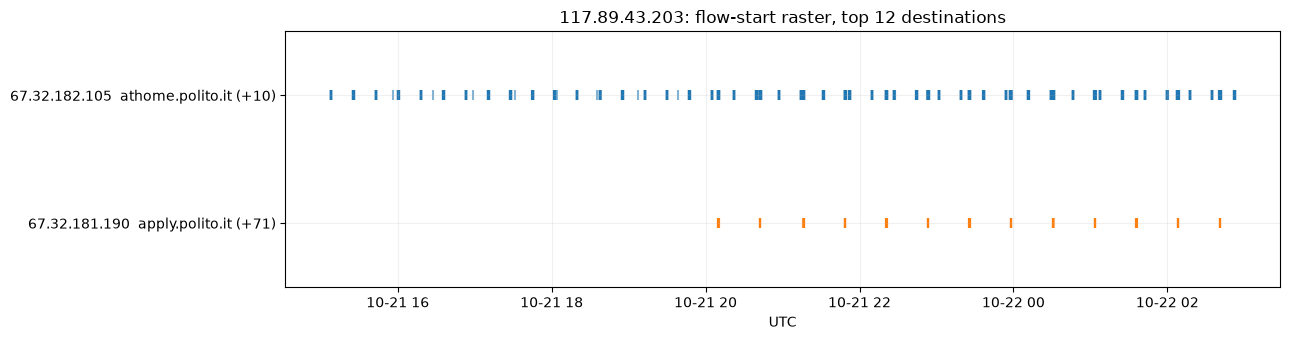
A separate activity. The slower pace, activity over several days, start before disclosure and different fingerprints do not support automatically grouping this IP with the AWS sources. The behaviour is consistent with automated crawling, monitoring or scanning; intent and operator remain unattributed.
China Telecom fingerprints and destinations
Across the full capture, the median interval between flow starts is 1.221 seconds. Towards www2.polito.it, the median and p90 of server bytes are 5,393; 96.5% of bidirectional flows contain a client-side RST. These patterns help characterise the activity, but do not prove malicious intent.
A link between some sources, without attribution to the vulnerability.
The China Telecom source remains separate. The most specific connection concerns the five AWS OAST identifiers.
Concentrated probing and correlated tokens.
Many connections to a few services. Five AWS sources use different OAST identifiers with a common XID machine fingerprint and similar apparent delays.
A possible shared infrastructure.
The data are consistent with automated security testing or vulnerability assessment. For at least five AWS sources, a link emerges in the software or token generation.
Attribution and exploitation remain unresolved.
A single operator, Nuclei or PHP2SHELL-specific tests have not been identified. Callbacks, successful exploitation, compromises or firewall bypass have not been demonstrated.
Temporal correlation suggests where to look. Identifiers link some sources. Application logs are needed to determine what they requested from the servers.
Comparison with HTTP/TLS access logs can verify URIs, request sequences and possible specific indicators. Their absence from Tstat counters does not rule out exploit attempts.
Data, checks and limitations.
Definitions and scopes for interpreting the results correctly.
Subsequent CTI and reachability checks · 1 November 2026
The checks reported in the analysis provided no additional attribution evidence. For the 12 AWS sources, all HTTPS/443 tests timed out; Shodan InternetDB had no information for 11 IPs. For 52.16.179.239 it reported NGINX on HTTP/80, but the HTTP attempt also timed out.
For China Telecom, GreyNoise reported noise: false and riot: false; InternetDB had no information. HTTP/80 and HTTPS/443 attempts timed out.
The absence of CTI data does not establish benign activity. Timeouts do not prove that the instances were decommissioned: filtering and unreachability are alternative explanations. These later checks do not reconstruct the configuration on 21 October.
Explore the 17 selected clients
| Source IP | Origin | Flows | Destination IPs |
|---|---|---|---|
18.201.21.207 | AWS EC2 | 20,098 | 1 |
3.248.215.18 | AWS EC2 | 7,841 | 3 |
204.62.215.43 | CyCognito | 7,221 | 3 |
54.216.130.236 | AWS EC2 | 6,759 | 2 |
52.213.232.181 | AWS EC2 | 6,731 | 2 |
34.254.202.109 | AWS EC2 | 6,112 | 1 |
3.253.44.137 | AWS EC2 | 5,746 | 1 |
54.216.127.195 | AWS EC2 | 5,560 | 1 |
108.129.137.22 | AWS EC2 | 5,324 | 1 |
3.250.17.39 | AWS EC2 | 5,163 | 1 |
108.133.97.79 | AWS EC2 | 4,901 | 1 |
3.254.184.143 | AWS EC2 | 4,628 | 1 |
52.16.179.239 | AWS EC2 | 4,181 | 1 |
204.62.215.1 | CyCognito | 3,883 | 21 |
117.89.43.203 | China Telecom | 748 | 1 |
82.54.158.95 | Telecom Italia | 375 | 2 |
37.186.234.114 | Fastweb | 261 | 2 |
The 748 China Telecom connections shown here are a subset of the 2,856 bidirectional flows in the full-capture analysis. Different scopes must not be added together or compared as if they were equivalent.
Data source and limitations
Figures retain their original source labels. The accompanying English captions explain the axes, legends and interpretation.
The analysis is based on logs produced by Tstat, a passive monitoring tool that collects flow statistics on the Politecnico di Torino network. The subset considered covers TCP/443; it does not describe other ports or UDP/443 traffic.
The planned capture runs from 20 October 2026 at 00:00 to 24 October at 00:00, excluding the final endpoint. The main temporal charts show 12 hours, from 21 October at 15:00 to 22 October at 03:00. The firewall interval used by the filter runs from 21 October at 14:48 to 22 October at 12:42, excluding the final endpoint. The selection’s unofficial marker is 20 October at 16:00; the official marker is 21 October at 15:00. Times remain as recorded in the dataset and do not change the overall operational timeline.
The ranking of 50 candidates uses all attempts towards inventory IPs, with first observation no earlier than the unofficial marker. The main population requires complete records, c_pkts_data:8 > 0 and s_bytes_uniq:21 > 0, and at least 100 flows meeting these conditions per source during the firewall interval. Resets after data exchange do not exclude a flow. This selection is not a census of all clients or all scanners.
The detailed analyses explicitly distinguish this sample from counts of all AWS attempts, the OAST search across the full complete-record capture, and the China Telecom analysis across all TCP/443 destinations. Tstat’s “incomplete” label alone does not prove a failed TCP handshake; “complete” does not establish TLS/HTTP success. Connection concurrency is unavailable because a recognised datetime end timestamp is missing.
SNI is TLS metadata observed in an individual flow. Inventory aliases do not automatically identify the requested virtual host. Missing SNI may reflect client behaviour or parser visibility. The negative OAST search result for other sources applies only to SNI visible in complete records.
PTR, ASN and RDAP registration are enrichment information, not verified attribution. They describe the state at lookup time. Flow-size fingerprints do not identify software; the XID machine ID can be shared, configured or replicated. The interval between an episode’s first and last flow starts is not session duration.
References
- M. Mellia, R. Lo Cigno, F. Neri, Measuring IP and TCP behavior on edge nodes with Tstat, Computer Networks, 47(1), 1–21, 2005.
- A. Finamore, M. Mellia, M. Meo, M. M. Munafò, D. Rossi, Experiences of Internet Traffic Monitoring with Tstat, IEEE Network, 25(3), 8–14, 2011.
- ProjectDiscovery, Interactsh: documentation and correlation ID structure.
- rs/xid, XID format and identifier fields.